Scroll Chiller vs. Screw Chiller: What is the Difference?
Two chiller quotes can show the same tonnage and still describe very different machines. One uses several scroll compressors. The other uses screw compressors. Which belongs in your plant? When comparing a scroll chiller vs screw chiller, start with how your process runs. Peak cooling demand is part of the decision, but so are light loads, temperature control and service needs.
Scroll and Screw Chillers Compress Refrigerant Differently
Both use a compressor to raise refrigerant pressure so the system can reject heat through its condenser. The difference is how they compress that refrigerant.
A scroll compressor uses two spiral-shaped scrolls. One stays fixed while the other orbits, trapping refrigerant vapor in pockets that get smaller as they move toward the center.
A screw compressor uses rotating helical elements to trap and compress refrigerant. Twin-screw designs use two intermeshing rotors.
| Feature | Scroll chiller | Screw chiller |
| Compression mechanism | A fixed scroll and an orbiting scroll compress refrigerant | Rotating helical elements compress refrigerant |
| Capacity control | Compressor staging, digital modulation or variable speed | Slide-valve unloading, variable speed or a combination |
| Common application | Small to medium loads, including larger multi-compressor systems | Medium to large cooling loads |
Both types can be air-cooled or water-cooled. Compressor design and condenser type are separate choices.
Cooling Capacity Alone Does Not Decide the Compressor Type
There is no universal tonnage where a scroll chiller stops making sense and a screw chiller becomes mandatory. Capacity ranges overlap, and manufacturers combine multiple compressors to serve larger loads.
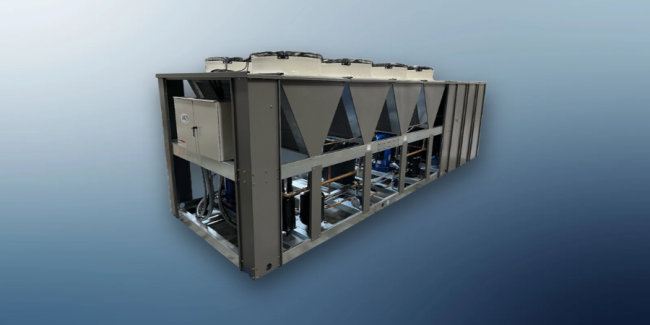
Our 80-ton ACWC-960-GC portable chiller for example, uses six-stage scroll compression. Its controls stage compressors on and off as demand changes. This shows why total chiller capacity alone does not decide the compressor type.
Check available capacity at your operating conditions. Nominal tonnage alone does not tell you how much cooling the unit will deliver with colder fluid or hotter outdoor air.
Part-Load Control Affects Cycling and Temperature Stability
A chiller sized for full production may spend hours cooling only part of the plant. How it handles that reduced load deserves attention.
A fixed-speed scroll system typically adjusts output by starting and stopping compressors in stages. Digital and variable-speed scroll designs offer other ways to match demand. Copeland’s digital scroll technology, for example, varies capacity through controlled loading and unloading.
Screw chillers commonly adjust capacity through a slide valve, compressor speed or both. Their minimum output and efficiency depend on the design.
Ask how low the complete chiller can operate while maintaining your required temperature. Minimum compressor output, control settings and fluid volume work together. Our chiller temperature guide explains other conditions that affect stable process cooling.
Compare Efficiency at the Same Process Conditions
Neither compressor type wins every efficiency comparison. ASHRAE’s liquid-chilling guidance explains how operating conditions and capacity control affect chiller performance.
Request performance data using the same:
- Leaving-fluid temperature and coolant concentration
- Outdoor ambient or entering condenser-water temperature
- Full-load and expected part-load conditions
- Power basis, including which pumps and fans are counted
A building-cooling efficiency rating may not represent a process running year-round at a lower fluid temperature. Compare the conditions your equipment will actually see, then consider operating hours and electricity cost.
Compressor Service and Circuit Design Affect Downtime
Many hermetic scroll compressors are replaced rather than rebuilt in the field. Some screw compressors can be serviced or rebuilt, depending on their construction. Compare parts availability, technician access and likely repair time for the proposed equipment.
Also check the refrigerant circuits. Several compressors sharing one circuit do not provide the same fault isolation as independent circuits. A shared refrigerant leak or common control failure may stop more than one compressor.
Ask the supplier a practical question: If one compressor or circuit goes down, how much cooling remains available? Then check if that remaining capacity can support production.
Let Cold Shot Match the Chiller to Your Process
You do not need to settle the scroll-versus-screw debate before calling us. Bring the process requirements. We can review the heat load, minimum demand, fluid temperature, flow, operating hours and site conditions to help narrow the options.
Cold Shot Chillers offers portable air-cooled chillers, water-cooled chillers and custom chiller configurations for industrial process cooling. Contact our team with your application details, and let’s work through what your next chiller needs to do.