Do You Need an Ammonia Chiller System? What to Consider First
Ammonia has been used in industrial cooling for over a century. It works well, especially at large scale. But that does not mean it is the right fit for most facilities. If you are looking at an ammonia chiller system, it is worth understanding how it actually works, where it makes sense, and what you are taking on from an operations standpoint.
What is an Ammonia Chiller System?
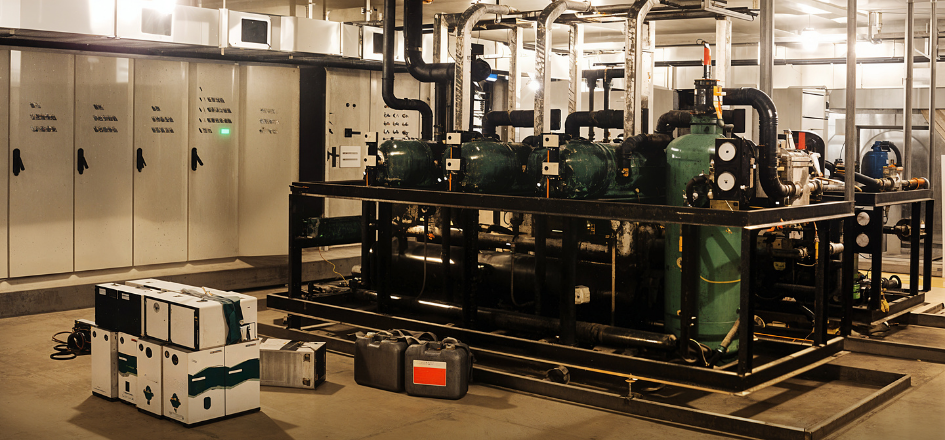
An ammonia chiller system uses ammonia (NH3) as the refrigerant. It removes heat from a process and rejects it somewhere else, usually outside the building. The system runs on a closed loop. The refrigerant changes state as it moves through the system.
Ammonia is used because:
- It has a high latent heat of vaporization
- It is very efficient in vapor compression systems
That means you can move a lot of heat with a relatively small amount of chiller refrigerant.
A typical system comprises:
- Compressor
- Condenser
- Evaporator
- Expansion device
Most ammonia systems are custom built, installed on site and designed around one facility. You typically don’t see them in smaller or general purpose cooling jobs.
How Does an Ammonia Chiller Work?
The basic cycle is the same as any vapor compression system. The difference is how ammonia behaves in the system.
- The compressor takes in low pressure ammonia vapor and compresses it. This raises both pressure and temperature.
- The hot, high pressure vapor moves to the condenser. Heat is rejected and the vapor condenses into a liquid.
- The liquid passes through an expansion device. Pressure drops quickly at this point.
- The low pressure liquid enters the evaporator. It absorbs heat from the process and boils back into a vapor.
Then it goes back to the compressor and repeats. Ammonia transfers heat quickly. That is one reason it is used in large refrigeration systems. It is not forgiving though. System design and control matter quite a bit.
Where Ammonia Chillers Actually Make Sense
An ammonia chiller system usually makes sense when:
- The load is large and steady
- The system runs most of the time (often 24/7)
- Energy cost is a major concern
- There are trained operators on site
Typical applications:
- Large food processing plants
- Cold storage warehouses
- Industrial refrigeration systems
- Chemical plants
These types of chillers are not light duty systems. They are built for constant operation. If the load is smaller or changes a lot, ammonia tends to be more system than you need.
Air Cooled Ammonia Chiller: is it Practical?
Air cooled ammonia chiller designs exist, but they are not common. An air cooled ammonia chiller is usually considered when water is not available or water treatment is an issue.
Most ammonia systems are water cooled. There are a couple reasons:
- Water removes heat more effectively
- System control is more stable at large scale
With air cooled ammonia systems, you give up some efficiency and you end up with a larger footprint. Support and service can also be more limited depending on the design.
For many facilities, a standard air cooled chiller using a synthetic refrigerant is simpler to install and easier to run.
Safety and Regulations
This is one of the biggest decision factors. Ammonia is toxic…it is also mildly flammable under certain conditions. Because of that, there are strict requirements around system design and operation.
You are typically looking at:
- Leak detection systems
- Ventilation requirements
- Trained operators
- Emergency procedures
In the states, many systems fall under OSHA PSM and EPA RMP regulations. That adds cost and ongoing responsibility. If your facility is not already set up for this, it is something to think through carefully before going too far.
Cost vs. Efficiency
Ammonia systems can be efficient, especially at large scale. But the full cost picture is not just energy use.
Pros:
- Good efficiency at high load
- Low refrigerant cost
- Long equipment life when maintained properly
Cons:
- High up front install cost
- Custom engineering required
- Ongoing compliance and chiller safety costs
Comparison Overview
| Ammonia Chiller System | Packaged Chiller (Synthetic) | |
| Install | Custom, on site | Factory built, fast install |
| Safety | High requirements | Lower risk profile |
| Operators | Required | Not required |
| Best Load | Very large, steady | Small to mid, variable |
| Upfront Cost | High | Lower |
| Flexibility | Low | High |
For a lot of facilities, packaged chillers end up being the more practical option. They are easier to install and do not carry the same operational burden as ammonia chillers.
Ammonia vs. The Alternatives
In most industrial settings, the choice comes down to risk and scale:
- Glycol Systems (Secondary Loop): Unlike ammonia, which circulates through your entire facility, glycol systems keep the refrigerant contained in the chiller. A food-safe glycol solution does the heavy lifting, making the system safer, easier to pipe, and simpler to maintain.
- Synthetic “Freon” Systems: While ammonia requires a custom-built plant and steel piping, synthetic systems come as packaged units. They are plug-and-play, use standard copper components, and avoid the massive regulatory burden (PSM/RMP) that comes with ammonia.
When an Ammonia Chiller is Not the Right Fit
In many cases, ammonia is not the best option when:
- Load is under ~100-200 tons
- Operation is not continuous
- There are no trained operators on site
- Safety and compliance resources are limited
In these situations, a packaged process chiller system is usually the better choice. It is simpler to install, easier to maintain, and more flexible if your load changes.
Explore Your Cooling Options at Cold Shot Chillers
Cold Shot Chillers is a trusted water chiller manufacturer that focuses on practical cooling systems that are easier to install and operate. In many cases, a properly sized packaged chiller will handle the load without the added complexity of ammonia. We offer air- and water-cooled chillers, replacement parts, as well as resources for chiller maintenance and chiller repair.
Contact Cold Shot Chillers today to discuss industrial cooling solutions.